What Olympic athletes see that viewers don’t: Machine-made snow makes ski racing faster and riskier – and it’s everywhere
US Olympic skiers and scientists explain the sharp differences between natural snow and machine-made snow, from the science to the rising risk of crashes.
Keith Musselman, Assistant Professor in Geography, Mountain Hydrology, and Climate Change, University of Colorado Boulder, Agnes Macy, Graduate Student in Geography, University of Colorado Boulder
11 February 2026
When viewers tune in to the 2026 Winter Olympics, they will see pristine, white slopes, groomed tracks and athletes racing over snow-covered landscapes, thanks in part to a storm that blanketed the mountain venues of the Italian Alps with fresh powder just in time.
But at lower elevations, where cross-country and other events are held, athletes and organizers have been contending with rain; thin, sometimes slushy snow; and icy, machine-made surfaces.
“Most of our races are on machine-made snow,” 2026 U.S. Olympic team cross-country skier Rosie Brennan told us ahead of the Games. “TV production is great at making it look like we are in wintry, snowy places, but this year has been particularly bad.”
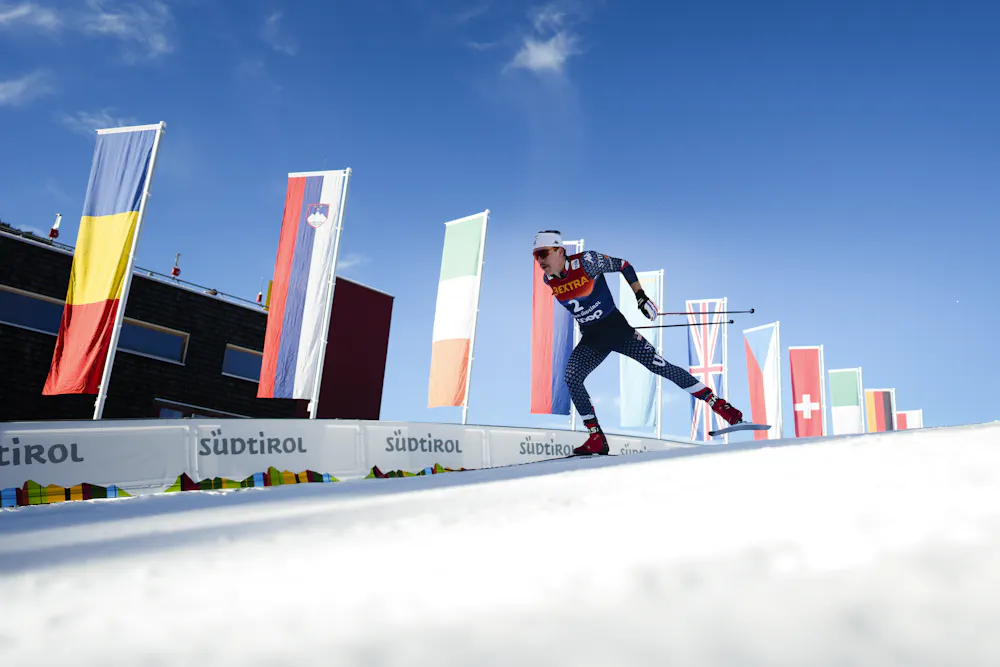
Machine-made snow increasingly makes the Winter Games possible. It’s also slicker to race and harder to fall on. Here, Olympic skier Ben Ogden of the U.S. competes during the sprint of the FIS Cross-Country World Cup Tour de Ski in Toblach, Italy, on Dec. 28, 2024.Federica Vanzetta/NordicFocus/Getty Images
Olympic athletes experience changing winter conditions personally, in ways the public and scientists rarely do. Lack of snowfall and more frequent rain affect when and where they can train, how they train and how dangerous the terrain can become.
We talked with Brennan and cross-country skiers Ben Ogden and Jack Young as they were preparing for the 2026 Winter Games. Their experiences reflect what many athletes describe: a sport increasingly defined not by the variability of natural winter but by the reliability of industrialized snowmaking.
What the cameras don’t show
Snowmaking technology makes it possible to create halfpipes for freestyle snowboarding and skiing competitions. It also allows for races when natural snow is scarce – the 2022 Winter Olympics in Beijing relied entirely on machine-made snow for many races.
However, machine-made snow creates a very different surface than natural snow, changing the race.
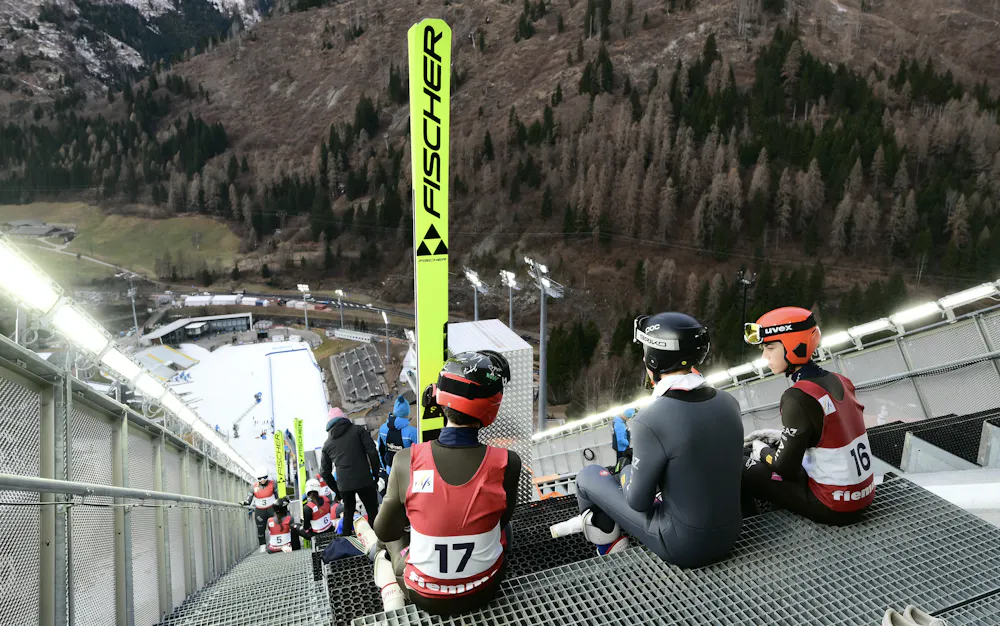
Athletes train at the ski jumping arena prior to the Open Italian Championship in Predazzo, a 2026 Winter Olympics venue, on Dec. 23, 2025.Stefano Rellandini/AFP via Getty Images
In clouds, each unique snowflake shape is determined by the temperature and humidity. Once formed, the iconic star shape begins to slowly erode as its crystals become rounded spheres. In this way, natural snow provides a variety of textures and depths: soft powder after a storm, firm or brittle snow in cold weather, and slushy, wet snow during rain or melt events.
Machine-made snow varies less in texture or quality. It begins and ends its life as an ice pellet surrounded by a thin film of liquid water. That makes it slower to change, easier to shape, and, once frozen, it hardens in place.
‘They’re faster, icier and carry more risk’
When artificial snow is being made, the sound is piercing – a high-pitched hiss roars from the pressurized nozzles of snow guns. These guns spew water mixed with compressed air, and it freezes upon contact with the cold air outside, creating small, dense ice particles. The drops sting exposed skin, as one of us, Agnes Macy, knows well as a former competitive skier.
Snow machines then push out artificial snow onto the racecourse. Often, the trails are the only ribbons of snow in sight – a white strip surrounded by brown mud and dead grass.
The surrounding landscape was mostly snow-free when Rosie Brennan competed in the individual sprint at an FIS Cross-Country World Cup event in Drammen, Norway, on March 3, 2022.Federico Modica/NordicFocus/Getty Images
“Courses built for natural snow feel completely different when covered in man-made snow,” Brennan, 37, said. “They’re faster, icier, and carry more risk than anyone might imagine for cross-country skiing.”
There’s nothing quite like skiing on fresh snow. After a storm brings a blanket of light, fluffy powder, it can almost feel as though you’re floating. The snow is forgiving.
On artificial snow, skiers carry more speed into downhill runs. Downhill racers may relish the speed, but cross-country skis don’t have metal edges like downhill skis do, so step-turning or skidding around fast, icy corners can make an athlete feel out of control. It “requires a different style of skiing, skill sets and strengths than I grew up learning,” Brennan said.
How athletes adapt, with help from science
Athletes must adjust their technique and prepare their skis differently, depending on the snow conditions.
At elite levels, this is science. Snow crystal morphology, temperature, ski base material and structure, ski stiffness, skier technique and environmental conditions all interact to determine an athlete’s speed.
How snow forms. NBC News Learn.
Before cross-country, or Nordic, races, ski technicians compare multiple ski pairs prepared with different base surfaces and waxes. They evaluate how quickly each ski glides and how long it maintains that glide – traits that depend on the friction between the ski and the snow.
Russia’s Alexander Terentev, right, and Czech Republic’s Michal Novak crash during a men’s cross-country sprint quarterfinal race at the FIS Nordic World Ski Championships in Oberstdorf, Germany, on Feb. 25, 2021.AP Photo/Matthias Schrader
While fast skiing is the goal, ski crashes are also the most common cause of injury in the Winter Olympics. With machine-made snow, ski jump competitors and anyone who falls is also landing on a harder surface, which can increase the risk of injury.
In the Alps, air temperature has increased by about 3.6 degrees Fahrenheit (2 degrees Celsius) since the late 1800s, before rising fossil fuel use began increasing the levels of greenhouse gases trapping heat in the atmosphere. Globally, 2025 was the third-warmest year on record, following 2024 and 2023.
Midwinter snowmelt events are occurring more often at higher elevations and earlier in the season across many mountain ranges of western North America. At the same time, the snow line – the elevation where precipitation shifts from snow to rain – is moving upslope.
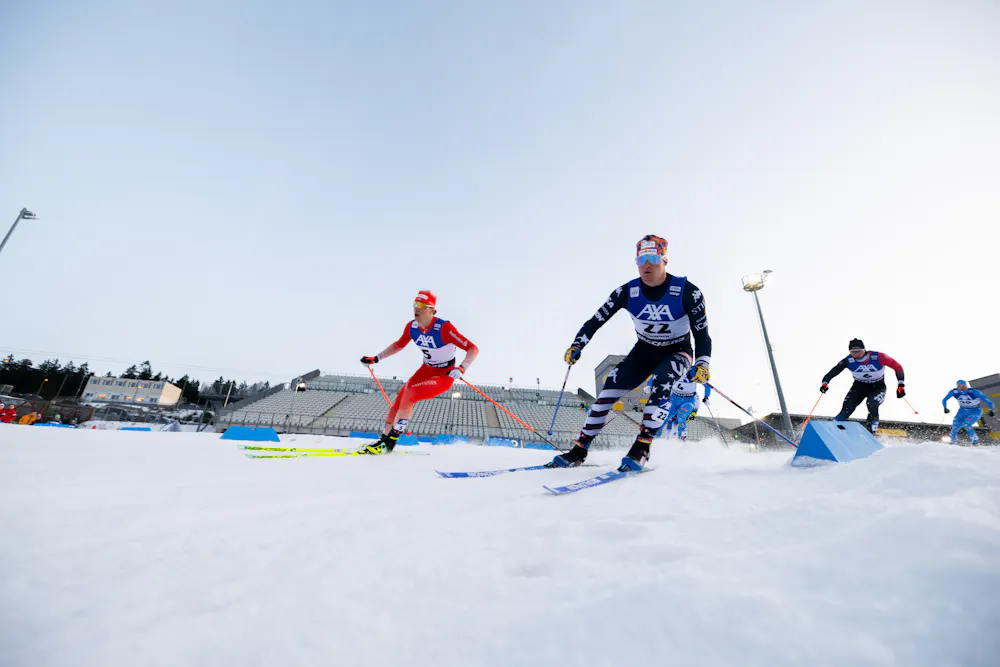
Taking sharp corners on icy surfaces isn’t easy on cross-country skis. Here, U.S. Olympic skier Jack Young competes in the individual sprint finals of the FIS Cross-Country World Cup Oberhof on Jan. 17, 2026, in Oberhof, Germany.Leo Authamayou/NordicFocus/Getty Images
Together, these changes mean that many winter storms produce less snow, over less area, and for shorter durations than they did a generation ago.
Training venues
The changing winter landscape has also transformed how athletes train. Traditional training venues, such as glaciers once used for summer skiing, have become unreliable. In August 2025, the Hintertux Glacier – the only year-round training center operating in Austria – announced its first temporary closure.
“It’s been increasingly hard to make plans for locations to train between races,” Brennan said. “Snow reliability isn’t great in many places. We often rely on going to higher elevations for a better chance of snow.”
Higher-elevation training can help, but it concentrates athletes in fewer places, reduces access for younger skiers due to the remoteness and raises costs for national teams. Some of these glaciers – like Canada’s Haig Glacier or Alaska’s Eagle Glacier – are accessible only by helicopter. When skiers can’t get to snow, dryland training on rollerskis is one of the only options.
Winter athletes see the climate changing
Because winter is their workplace, athletes often notice subtle changes before those changes show up in long-term statistics.
Even athletes in their earlier 20s, like Young, said they have noticed the rapid expansion of snowmaking infrastructure at many racing venues in recent years. Snowmaking requires large amounts of energy and water. It is also a clear sign that organizers see winters becoming less dependable.
Winter athletes like Canadian Dahria Beatty are seeing their environment change as temperatures rise.
Athletes also witness how communities are affected when poor snow conditions mean fewer visitors. “In the Alps, when conditions are bad, it is obvious how much it affects the communities,” Ogden, 25, said. “Their tourism-based livelihoods are so often negatively affected, and their quality of life changes.”
Many winter athletes are speaking publicly about their concerns. Groups such as Protect Our Winters, founded by professional snowboarder Jeremy Jones, work to advance policies that protect outdoor places for future generations.
A wintry look, but an uncertain future
For athletes at the 2026 Olympics, the variability within the Olympic region – snow at higher elevations, rain at lower ones – reflects a broader truth: The stability of winter is diminishing.
Athletes know this better than anyone. They race in it. They train in it. They depend on it.
The Winter Games will go on this year. The snow will look good on television. But at the same time, winter is changing.
Keith Musselman receives funding from the National Science Foundation. He is a member of the Science Alliance for the non-profit Protect Our Winters.
Agnes Macy receives funding from the National Science Foundation.
This article is republished from The Conversation under a Creative Commons license.