ICE killing of driver in Minneapolis involved tactics many police departments warn against - but not ICE itself
Police departments have changed their policies regarding use of force over the years to protect life, but ICE and other federal agencies have lagged in this regard.
Ben Jones, Assistant Professor of Public Policy and Research Associate in the Rock Ethics Institute, Penn State
10 January 2026
Minneapolis is once again the focus of debates about violence involving law enforcement after an Immigration and Customs Enforcement officer shot and killed Renee Nicole Good, a 37-year-old mother, in her car.
The shooting will also likely prompt renewed scrutiny of training and policy of officers and the question of them shooting at moving vehicles. There has been a recent trend in law enforcement toward policies that prohibit such shootings. It is a policy shift that has shown promise in saving lives.
Debates over deadly force are often contentious, but as I note in my research on police ethics and policy, for the most part there is consensus on one point: Policing should reflect a commitment to valuing human life and prioritizing its protection. Many use-of-force policies adopted by police departments endorse that principle.
Yet, as in Minneapolis, controversial law enforcement killings continue to occur. Not all agencies have implemented prohibitions on shooting at vehicles. Even in agencies that have, some policies are weak or ambiguous.
In addition, explicit prohibitions on shooting at vehicles are largely absent from the law, which means that officers responsible for fatal shootings of drivers that appear to violate departmental policies still often escape criminal penalties.
In the case of ICE, which is part of the Department of Homeland Security, its policy on shooting at moving vehicles – unlike that of many police agencies – lacks a clear instruction for officers to get out of the way of moving vehicles where feasible. It’s an omission at odds with generally recognized best practices in policing.
ICE’s policy on shooting at moving vehicles
ICE’s current use-of-force policy prohibits its officers from “discharging firearms at the operator of a moving vehicle” unless it is necessary to stop a grave threat. The policy is explicit that deadly force should not be used “solely to prevent the escape of a fleeing suspect.”
That point is relevant for evaluating the fatal shooting in Minneapolis. Videos show one officer trying to open the door of the vehicle that Good was driving, while another officer appears to be in front of the vehicle as she tried to pull away.
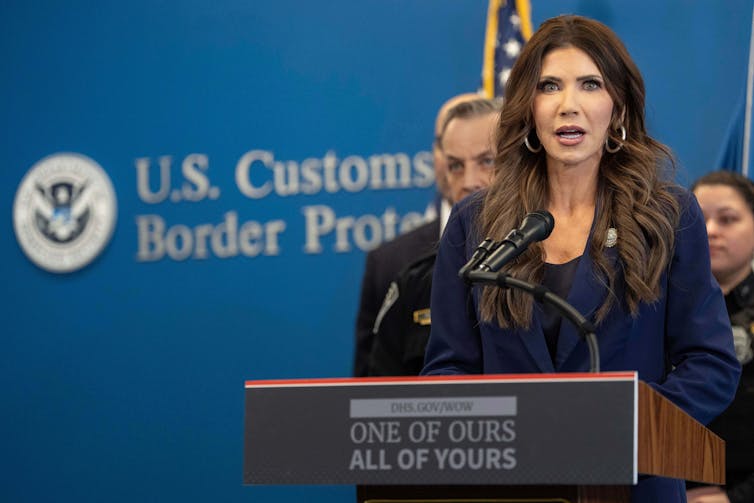
Homeland Security Secretary Kristi Noem said that an ICE officer ‘feared for his life’ before shooting a woman in Minneapolis.AP/Yuki Iwamura
Shooting to prevent the driver simply from getting away would have been in violation of agency policy and obviously inconsistent with prioritizing the protection of life.
ICE’s policy lacks clear instruction, however, for its officers to get out of the way of moving vehicles where feasible. In contrast, the Department of Justice’s use-of-force policy makes it explicit that officers should not shoot at a vehicle if they can protect themselves by “moving out of the path of the vehicle.”
Notably, President Joe Biden issued an executive order in 2022 requiring federal law enforcement agencies – like ICE – to adopt use-of-force policies “that are equivalent to, or exceed, the requirements” of the Department of Justice’s policy.
Despite that order, the provision to step out of the way of moving cars never made it into the use-of-force policy that applies to ICE.
The rationale for not shooting at moving vehicles
Prioritizing the protection of life doesn’t rule out deadly force. Sometimes such force is necessary to protect lives from a grave threat, such as an active shooter. But it does rule out using deadly force when less harmful tactics can stop a threat. In such cases, deadly force is unnecessary – a key consideration in law and ethics that can render force unjustified.
That’s the concern involved with police shooting at moving vehicles. It often is not necessary because officers have a less harmful option to avoid a moving vehicle’s threat: stepping out of the way.
This guidance has the safety of both suspects and police in mind. Obviously, police not shooting lowers the risk of harm to the suspect. But it also lowers the risk to the officer in the vast majority of cases because of the laws of physics. If you shoot the driver of a car barreling toward you, that rarely brings a car to an immediate stop, and the vehicle often continues on its path.
Many police departments have incorporated these insights into their policies. A recent analysis of police department policies in the 100 largest U.S. cities found that close to three-quarters of them have prohibitions against shooting at moving vehicles.
The gap between policy and best practices for protecting life
The shooting in Minneapolis serves as a stark reminder of the stubborn gap that often persists between law and policy on the one hand and best law enforcement practices for protecting life on the other. When steps are taken to close that gap, however, they can have a meaningful impact.
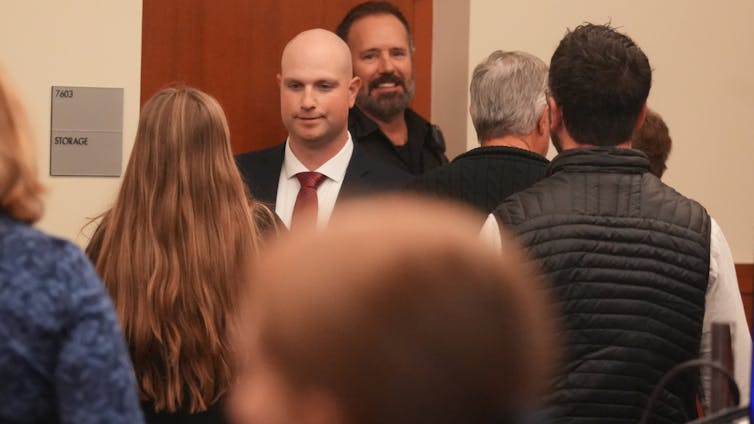
Connor Grubb, a police officer in Blendon Township, Ohio, was acquitted in November of charges stemming from a killing that involved a pregnant woman fleeing in a car.Doral Chenoweth/AP
Some of the most compelling examples involve local, state and federal measures that reinforce one another. Consider the “fleeing felon rule,” which used to allow police to shoot a fleeing felony suspect to prevent their escape even when the suspect posed no danger to others.
That rule was at odds with the doctrine of prioritizing the protection of life, leading some departments to revise their use-of-force policies and some states to ban the rule. In 1985, the U.S. Supreme Court ruled that it was unconstitutional for police to shoot a fleeing suspect who was not a danger.
This history suggests that clear bans in law and policy on questionable tactics have the potential to save lives, while also strengthening the means for holding officers accountable.
Ben Jones does not work for, consult, own shares in or receive funding from any company or organization that would benefit from this article, and has disclosed no relevant affiliations beyond their academic appointment.
This article is republished from The Conversation under a Creative Commons license.