A 2,000-year-old building site reveals the raw ingredients for ancient Roman self-healing concrete
This has re-written our understanding of how Romans manufactured concrete.
Ray Laurence, Professor of Ancient History, Macquarie University
10 December 2025
Roman concrete is pretty amazing stuff. It’s among the main reasons we know so much about Roman architecture today. So many structures built by the Romans still survive, in some form, thanks to their ingenious concrete and construction techniques.
However, there’s a lot we still don’t understand about exactly how the Romans made such strong concrete or built all those impressive buildings, houses, public baths, bridges and roads.
Scholars have long yearned for more physical evidence from Roman worksites to provide clues.
Now, a new study – led by researchers from the Massachusetts Institute of Technology (MIT) and published in the journal Nature Communications – sheds new light on Roman concrete and construction techniques.
That’s thanks to details sifted from partially constructed rooms in Pompeii – a worksite abandoned by workers as Mount Vesuvius erupted in 79 CE.
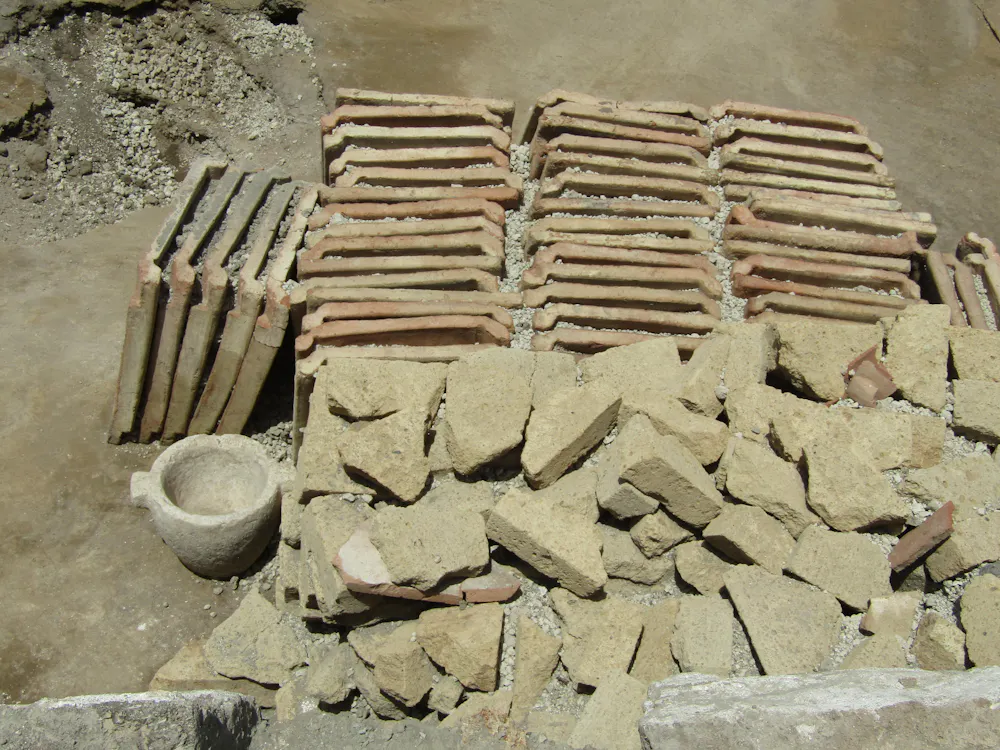
Neatly aligned ceramic roof tiles and tuff blocks at a newly excavated site in Pompeii, documenting the organised storage of building materials ready for reuse during renovation.Archaeological Park of Pompeii
New clues about concrete making
The discovery of this particular building site hit the news early last year.
The builders were quite literally repairing a house in the middle of the city, when Mount Vesuvius blew up in the first century CE.
This unique find included tiles sorted for recycling and wine containers known as amphorae that had been re-used for transporting building materials.
Most importantly, though, it also included evidence of dry material being prepared ahead of mixing to produce concrete.
It is this dry material that is the focus of the new study. Having access to the actual materials ahead of mixing represents a unique opportunity to understand the process of concrete making and how these materials reacted when water was added.
This has re-written our understanding of Roman concrete manufacture.
Self-healing concrete
The researchers behind this new paper studied the chemical composition of materials found at the site and defined some key elements: incredibly tiny pieces of quicklime that change our understanding of how the concrete was made.
Quicklime is calcium oxide, which is created by heating high-purity limestone (calcium carbonate).
The process of mixing concrete, the authors of this study explain, took place in the atrium of this house. The workers mixed dry lime (ground up lime) with pozzolana (a volcanic ash).
When water was added, the chemical reaction produced heat. In other words, it was an exothermic reaction. This is known as “hot-mixing” and results in a very different type of concrete than what you get from a hardware store.
Adding water to the quicklime forms something called slaked lime, along with generating heat. Within the slaked lime, the researchers identified tiny undissolved “lime clasts” that retained the reactive properties of quicklime. If this concrete forms cracks, the lime clasts react with water to heal the crack.
In other words, this form of Roman concrete can quite literally heal itself.
Pompeii Archeological Park site map, with showing where the ancient building site is located, with colour coded piles of raw construction materials (right): purple: debris; green: piles of dry pre-mixed materials; blue: piles of tuff blocks.Masic et al, Nature Communications (2025)
Techniques old and new
However, it is hard to tell how widespread this method was in ancient Rome.
Much of our understanding of Roman concrete is based on the writings of the ancient Roman architect Vitruvius.
He had advised to use pozzolana mixed with lime, but it had been assumed that this text did not refer to hot-mixing.
Yet, if we look at another Roman author, Pliny the Elder, we find a clear account of the reaction of quicklime with water that is the basis for the exothermic reaction involved in hot-mixing concrete.
So the ancients had knowledge of hot-mixing but we know less about how widespread the technique was.
Maybe more important is the detail in the texts of experimentation with different blends of sand, pozzolana and lime, leading to the mix used by the builders in Pompeii.
The MIT research team had previously found lime clasts (those tiny little bits of quicklime) in Roman remains at Privernum, about 43 kilometres north of Pompeii.
It’s also worth noting the healing of cracks has been observed in the concrete of the tomb of noblewoman Caecilia Metella outside Rome on the Via Appia (a famous Roman road).
Now this new Pompeii study has established hot-mixing happened and how it helped improve Roman concrete, scholars can look for instances in which concrete cracks have been healed this way.
Questions remain
All in all, this new study is exciting – but we must resist the assumption all Roman construction was made to a high standard.
The ancient Romans could make exceptional concrete mortars but as Pliny the Elder notes, poor mortar was the cause of the collapse of buildings in Rome. So just because they could make good mortar, doesn’t mean they always did.
Questions, of course, remain.
Can we generalise from this new study’s single example from 79 CE Pompeii to interpret all forms of Roman concrete?
Does it show progression from Vitruvius, who wrote some time earlier?
Was the use of quicklime to make a stronger concrete in this 79 CE Pompeii house a reaction to the presence of earthquakes in the region and an expectation cracking would occur in the future?
To answer any of these questions, further research is needed to see how prevalent lime clasts are in Roman concrete more generally, and to identify where Roman concrete has healed itself.
Ray Laurence does not work for, consult, own shares in or receive funding from any company or organisation that would benefit from this article, and has disclosed no relevant affiliations beyond their academic appointment.
This article is republished from The Conversation under a Creative Commons license.